

Mainframes are highly available enterprise computing systems designed for the parallel processing of massive volumes of data and transactions—powerful, yet also highly complex. High licensing costs, aging IT workforce,
and constant workload changes mean that companies cannot afford inefficiency. For the difference between acceptable performance and peak performance often lies in overlooked details:
- Misconfigured WLM policies that do not align with business priorities
- Outdated system parameters that waste CPU cycles
- Memory and paging constraints that slow down workloads
- Inefficient I/O operations that consume unnecessary resources
By optimizing CICS, DB2, DDF, and batch processing environments, it is ensured that critical workloads receive prioritized access—and that systems remain responsive even under heavy load
Mainframe Optimization through direct Cost Control
Alongside performance optimization, cost control is considered one of the key success factors in mainframe optimization. In this context, there are several methods for the precise fine-tuning of systems that help to specifically optimize mainframe costs.
These methods include:
- MLC Optimization – Analysis of capping strategies to minimize software costs
- zIIP Utilization – Reduction of data traffic between zIIP and GCP, thereby lowering costs while simultaneously improving throughput
- Multithreading Activation – Safe enablement of efficiency-enhancing features, which, however, require expert oversight
- Processor Cache Utilization Optimization – Reduction of resource consumption
In practice, it is consistently demonstrated that just a few targeted adjustments within the scope of mainframe optimization are sufficient to realize significant cost savings—often faster and more effectively than many companies anticipate.
Capacity Planning in z/OS Operations as a Success Factor
Capacity planning is considered another key success factor in mainframe optimization. While mainframe capacity planning was once viewed merely as a desirable option, it has today evolved into a business-critical strategy. Companies that neglect it frequently find themselves confronted with the following problems:
- Performance bottlenecks during peak business hours
- Unplanned downtime that impacts customers and damages trust
- Rising costs due to inefficient utilization of mainframe systems and suboptimal workstation configurations
- Non-compliance with Service Level Agreements (SLAs), directly impacting revenue and compliance
Accordingly, companies that implement structured capacity planning achieve measurable benefits very quickly.
Mainframe Optimization: Performance Optimization, Cost Control, and Capacity Planning Unified
In our blog series, we will examine the topic of z/OS performance optimization in detail, demonstrating—among other things—which metrics are truly critical and how easily they can be visualized using z/INSIGHT. Much of this information has previously remained hidden. The primary reason is that identifying these key metrics often requires an enormous amount of effort. With z/INSIGHT, however, a single click is often all it takes to bring them to light. Problem analysis is greatly simplified, and as a result, the number of incidents drops significantly.
The systems become less prone to disruptions.
z/INSIGHT – SVA’s new Flagship for z/OS Mainframe Optimization
To address the challenges in a structured manner, SVA developed z/INSIGHT—a new software-based service for mainframe optimization. z/INSIGHT combines expert services with intelligent software, thereby creating a straightforward platform for deep-dive analysis.
The following graphic displays the z/INSIGHT dashboard, which clearly presents key data from the z/OS environment:
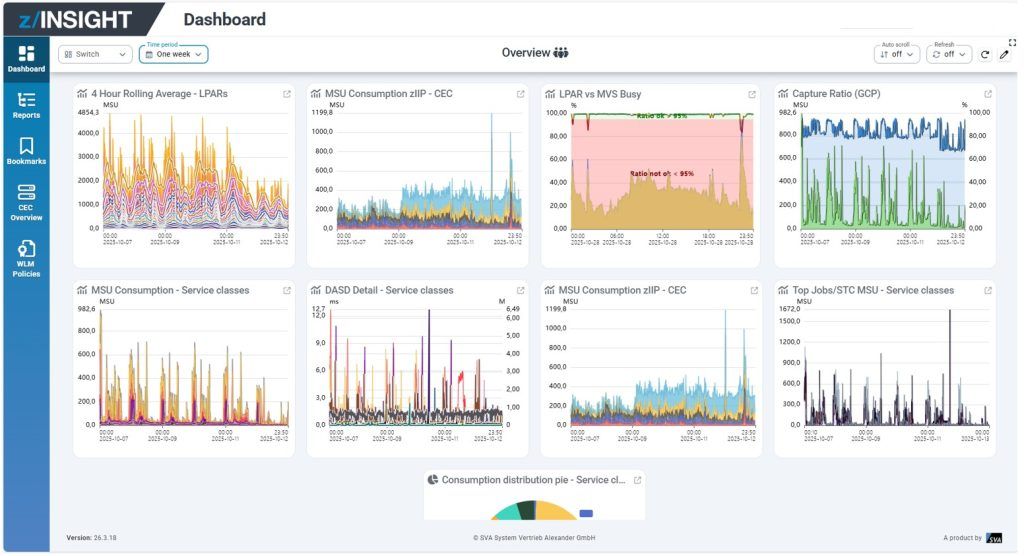
z/INSIGHT fundamentally simplifies and refines the analysis of SMF data. Within seconds, z/OS becomes fully transparent via a graphical interface—complete with subsystem support for environments such as CICS and DB2. New perspectives on metrics, resource consumption, and interdependencies—views that few other tools have previously made possible—significantly streamline z/OS administration.
In this way, the entire IT team receives precisely the results they need:
- Managers can see at a glance whether their z/OS systems are performing well or if issues exist.
- System analysts can determine how workloads are behaving and how they can be planned.
- System administrators maintain transparent visibility into costs, as well as whether their system settings are achieving their intended goals.
- Subsystem administrators can monitor the performance of specific components—such as transactional processes or SQL queries.
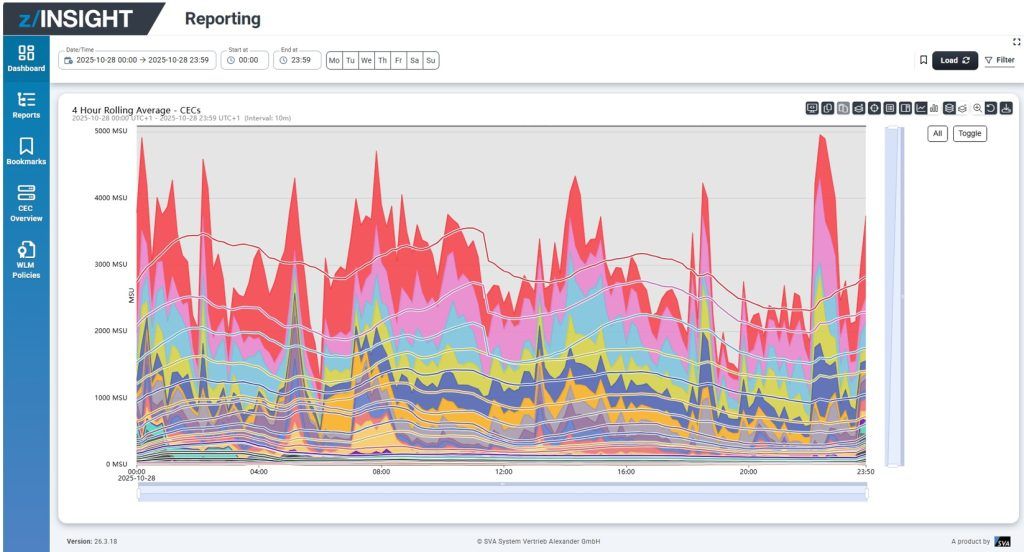
And all of this often with just a single click. The high level of skill and intensive personnel effort typically required to identify and analyze the right figures can be significantly reduced through z/INSIGHT.
Optimizing z/OS: Achieving greater Performance and Cost Transparency with the right Metrics
Whether it involves WLM fine-tuning, MLC optimization, or capacity planning, the greatest levers in z/OS operations often lie in a few—yet critical—adjustment points, provided that the right key metrics are readily available. With z/INSIGHT, SMF data becomes visible and analyzable within a clear, intuitive interface, thereby significantly reducing the effort required for analysis as well as the reliance on specialized expertise. This enables improvements in performance and stability—while simultaneously enhancing cost transparency..
For more information about z/INSIGHT, please visit the following link: z/INSIGHT: Software-based Service for Mainframe Optimization | sva.de
Transparency notice: This post was created by subject-matter experts. AI tools were used exclusively to support research and for language optimization.