

In our previous mainframe blog post, we explored how z/INSIGHT can help optimize LPAR management. In particular, we looked at how to assess whether a z/OS system is receiving adequate CPU resources from PR/SM.
However, when defining LPAR weights, an important question arises: Which workload LSPR is the right one for your z/OS LPARs?
What Is the Large System Performance Reference (LSPR)?
The Large System Performance Reference (LSPR) provides an assessment of relative processor capacity in an unconstrained environment for the specific benchmark workloads and operating systems listed in its tables.
These figures are based on IBM measurements and analyses, representing processor capacity under idealized conditions.
Understanding ITR and ETR: The Key Metrics
Internal Throughput Rate (ITR)
- measures the amount of work a processor can perform within a specific workload
- is the primary metric of the LSPR methodology
External Throughput Rate (ETR)
- evaluates overall system capacity while taking all resources into account – including memory, channels, control units, and I/O devices
- is relevant when comparing entire systems
However, numerous factors can cause reference values to differ from the actual system performance. The two most important factors are:
- CPU intensity of the workload
- I/O characteristics of the workload
Making an incorrect assumption can lead to inaccurate estimates when determining LPAR weights.
The Challenge of LPAR Weighting
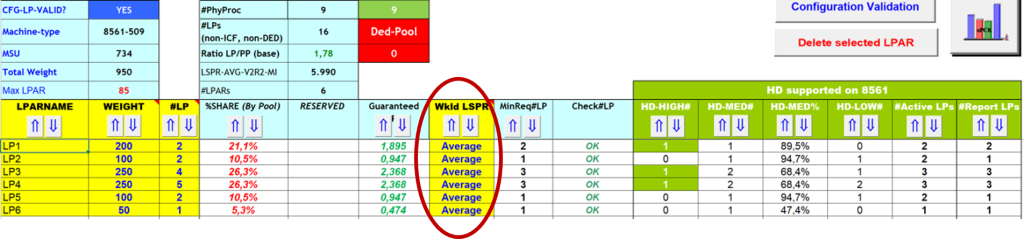
To calculate CPU settings, the LPAR Design Tool can be used. As shown in the figure below, the tool requires the LSPR ratio as an input parameter.
Most organizations determine LPAR weights based on an intuitive estimate. Whether that estimate is correct, is often not verified. In addition, performing such an estimation manually can take several days.
The potential deviation from reality is significant: workloads are either highly CPU or I/O-driven, with many variations in between. If the workload characteristics are estimated incorrectly, this can negatively affect the efficiency of processor cache utilization and, ultimately, overall system performance. So how can this challenge be addressed?
Just One Click to the Right Workload LSPR with z/INSIGHT
This is exactly where z/INSIGHT, the software-based service for mainframe optimization by SVA, comes into play. Instead of relying on intuitive estimates or assumptions, mainframe teams can analyze the actual workloads of their environment and determine the most appropriate workload LSPR with far greater accuracy and ease.
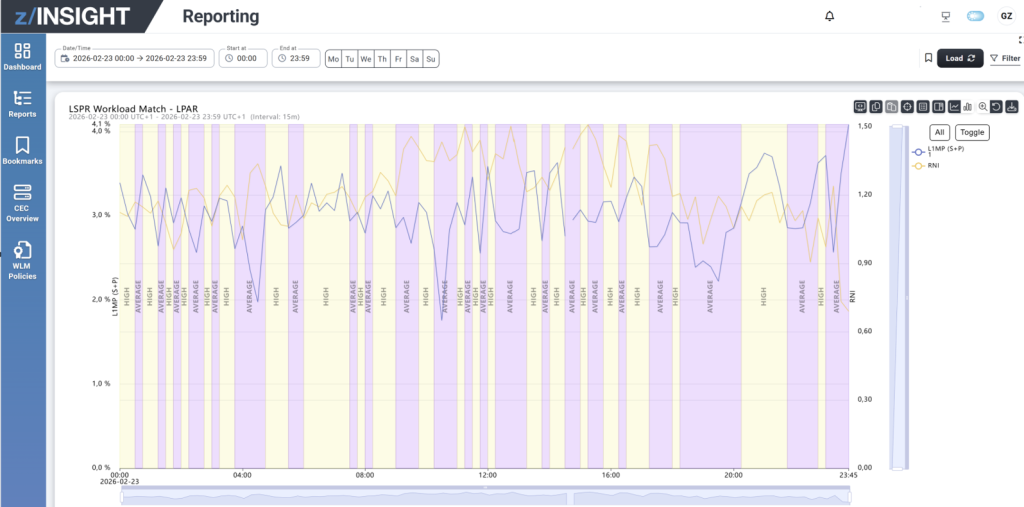
With just a few clicks, z/INSIGHT provides the information needed for a detailed assessment. Based on real data, our software shows which LSPR value is best suited for the specific LPAR.
The example shown here focuses on a single day of data. However, to obtain reliable and representative results, it is recommended to analyze data over several days or even weeks. Additional details can be seen by zooming into the charts using the controls on the right-hand side and at the bottom.
The result is a clear determination of the appropriate Average High value for the LPAR being analyzed. Unlike intuitive estimates or assumptions, this provides a much more reliable basis and can then be used directly as the input value in the LPAR Design Tool.
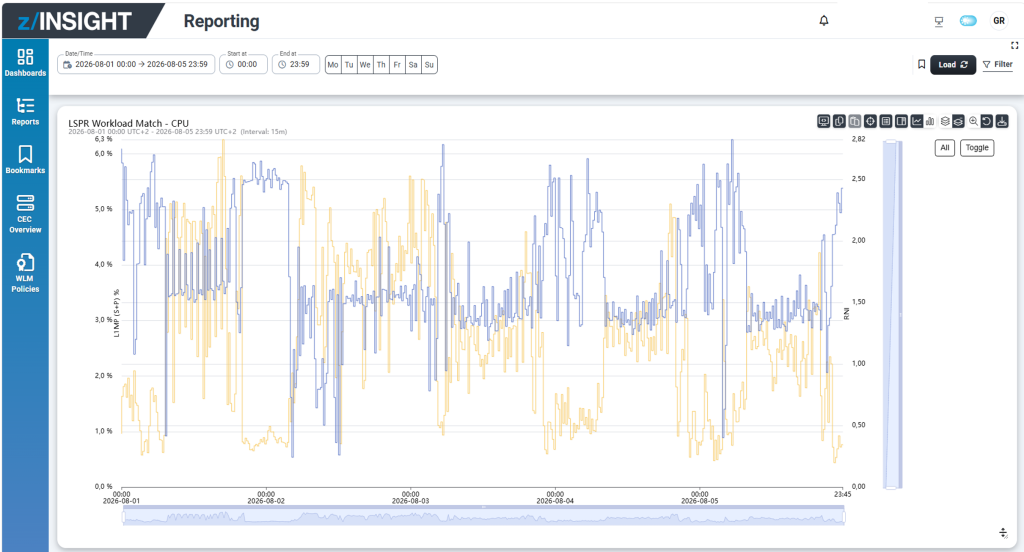
In addition, the CPU view in z/INSIGHT provides more detailed insights. These insights can be used to further validate the analysis results:
Conclusion: Greater Transparency for Better Mainframe Decisions
Selecting the right workload LSPR is often a time-consuming and risk-prone task. In many cases, it relies on assumptions or intuitive estimates that do not necessarily reflect the actual workload. At the same time, determining estimates can take several days.
With z/INSIGHT, the optimal workload LSPR can be identified at the click of a button – delivering fast, accurate, and data-driven results. This provides greater transparency into the system environment while reducing uncertainty when evaluating future capacity requirements and planning decisions.
Learn more about z/INSIGHT and discover how you can optimize your mainframe environment with a data-driven approach: https://www.sva.de/en/products/zinsight-software-based-service-mainframe-optimization